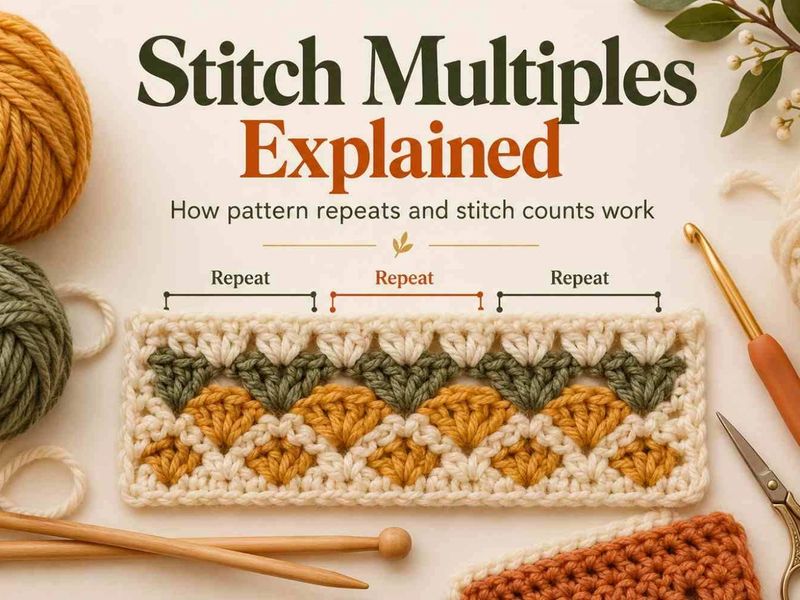
Stitch Multiples Explained: How to Read 'Multiple of 4 + 2' in Patterns
A plain-language guide to reading pattern math: what 'multiple of 4 + 2' actually means, how to separate repeat stitches from edge stitches, and how to check your work.
Maggie

Pattern gauge mismatch
When your blocked swatch differs from the pattern gauge, enter the pattern's original counts and your gauge to get adjusted stitches and rows for the same finished size.
Leave blank to keep the pattern's intended finished width.
The original row count you need to adjust.
Leave at 1 if there isn't one.
Leave blank to keep the pattern's intended finished length.
Live gauge preview
5 stitches per inch, 7 rows per inch
Your adjusted count
Based on your blocked gauge. Unblocked swatches lie.
Priya has a cardigan pattern written at 18 stitches over 4 inches. She knits at 20 stitches over 4 inches, making a tighter fabric. The pattern says cast on 96, in a multiple of 6.
Pattern gauge 18 sts ÷ 4 in = 4.50 sts/in
Pattern width 96 sts ÷ 4.50 = 21.33 in
Her gauge 20 sts ÷ 4 in = 5.00 sts/in
Raw stitches 21.33 in × 5.00 = 106.7
Valid counts 102, 108, 114 (6n)
Cast on 108 stitches
Her cardigan comes out 21.6 inches wide against the pattern's 21.3, a third of an inch larger, because 108 was the nearest count her stitch repeat allows. Casting on the pattern's 96 at her gauge would have given her 19.2 inches: over two inches too small, and unwearable.
When the raw stitch count lands exactly halfway between two valid counts such as 110, between 108 and 112 for a multiple of 4, this roundsup, not to the nearest even number and not down. A piece slightly too large is still wearable. Slightly too small is not. If you check our arithmetic by hand and get the lower number, that is why.
This calculator applies your blocked gauge to an existing pattern count. It turns the pattern's original gauge and count into a finished measurement, then finds the adjusted stitch or row count needed to keep that same measurement in your fabric. It does not calculate gauge from a swatch or grade a garment from scratch.
A tighter gauge needs more stitches across the same width; a looser gauge needs fewer. The result compares the original and adjusted measurements so you can see how closely the new count matches the pattern's intended size.
When a pattern uses a repeat such as a multiple of 4 plus 2, the raw result is adjusted to a count that still fits that structure. The tool shows the nearby valid options instead of hiding the rounding.
Need to understand gauge or turn a blocked swatch into a number first? Those jobs come before adjusting an existing pattern count.
Need to distribute the stitch change evenly? When a resized section ends up with more or fewer stitches than the row you have, the increase and decrease calculator spaces those increases or decreases evenly across the row.
Learn the method
A plain-language guide to reading pattern math: what 'multiple of 4 + 2' actually means, how to separate repeat stitches from edge stitches, and how to check your work.
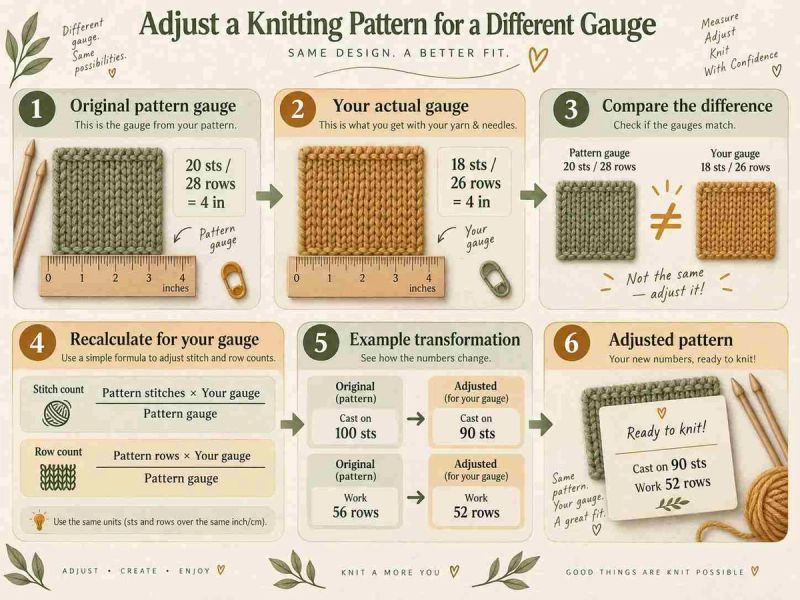
A practical method for resizing knitting patterns when your swatch gauge doesn't match the pattern, including worked examples, repeat constraints, and construction risks.