How to Increase and Decrease Stitches Evenly in Knitting and Crochet
A practical method guide for evenly spacing increases and decreases, with transparent arithmetic, worked examples, and when to use a calculator for exact distribution.
Maggie

A plain-language guide to reading pattern math: what 'multiple of 4 + 2' actually means, how to separate repeat stitches from edge stitches, and how to check your work.
A stitch multiple like 'multiple of 4 + 2' means your starting chain or cast-on must equal a number divisible by 4, plus 2 extra stitches for edges. For example: 4, 8, 12, 16... plus 2 gives you 6, 10, 14, 18 stitches total. The first number controls the repeating pattern motif; the second number adds selvedge or balance stitches that appear only once.
"Cast on a multiple of 4 + 2."
You read it three times. The lace chart looks straightforward, but now you're holding a pencil, scribbling numbers, wondering if this is a knitting pattern or a pop quiz. The stitches themselves aren't hard. The math gate is.
Here's the direct translation: a multiple of 4 + 2 means any number in the 4 times table, plus 2 extra stitches. 6, 10, 14, 18, 22, 26... any of these will work. The pattern doesn't care which you pick; it cares that your total fits the formula.
---
The first number is your repeat unit — the chunk of stitches that the pattern consumes over and over.
Think of it like tiling a floor. One tile = 4 stitches wide. Your room can be 4 tiles wide (16 stitches), 5 tiles wide (20 stitches), 6 tiles wide (24 stitches). The pattern doesn't specify how many tiles; it specifies the tile size.
If the pattern says... — Your repeat unit is... — Valid totals include...
Multiple of 3 — 3 stitches — 3, 6, 9, 12, 15, 18...
Multiple of 4 — 4 stitches — 4, 8, 12, 16, 20, 24...
Multiple of 6 — 6 stitches — 6, 12, 18, 24, 30, 36...
Multiple of 8 + 4 — 8 stitches, plus 4 — 12, 20, 28, 36, 44...
The "multiple of" language appears in both knitting and crochet because both crafts build fabric in repeating structural units. Designers use this shorthand so one instruction covers any project width.
---
The second number is not part of the repeat. It sits outside the tiling system. Typically these extra stitches are:
These stitches appear once, at the beginning and/or end of your row, regardless of how many repeats you work.
Pattern says: multiple of 4 + 2
You want a scarf about 18 stitches wide.
Your row structure becomes:
Section — Stitches — What happens there
Edge/balance — 1 stitch — Selvedge or setup
Repeat 1 — 4 stitches — Main pattern motif
Repeat 2 — 4 stitches — Main pattern motif
Repeat 3 — 4 stitches — Main pattern motif
Repeat 4 — 4 stitches — Main pattern motif
Edge/balance — 1 stitch — Selvedge or finish
Total — 18 stitches
The +2 splits as 1 stitch at each edge. Some patterns put all extra stitches on one side; the pattern should specify.
---
When a pattern gives only the formula, you may need to deduce the structure. Here's how:
"Multiple of 6 + 1. Row 1 (RS): K1, yo, ssk, k1, k2tog, yo, k1; repeat from to across, end k1."
Wait. Re-read: the ending k1 is shared — it's both the final stitch of the last repeat and the edge stitch. The pattern consumes it once but serves two jobs. This is common in lace where the edge stitch completes the final yarnover pair. The formula still holds: your cast-on is (6 × repeats) + 1, and the written row accounts for how that +1 gets used in the repeat logic.
Lesson: The formula tells you the starting count. The row instructions tell you how the designer routes those stitches. Trust the formula for cast-on; verify with the row text.
---
The math works identically, but the starting action differs.
Craft — Starting action — Special consideration
Knitting — Cast on stitches — Each cast-on stitch is one live loop
Crochet — Chain stitches — May need a turning chain that doesn't count as a stitch; check pattern
In crochet, some patterns say "chain a multiple of 4 + 2" and some say "work a foundation chain of..." The chain count is your raw total. But if Row 1 says "sc in 2nd ch from hook," you've already consumed one chain as a turning step. The pattern's stated multiple should already account for this, but designer conventions vary.
Caution: Some vintage crochet patterns treat the turning chain as part of the multiple; others don't. If your stitch count comes out wrong by exactly the turning-chain length, this is usually why.
---
Before you commit to 200 stitches, verify with a small swatch:
This catches edge-stitch errors before they become a frogged blanket.
Pattern: multiple of 6 + 3, desired width ~75 stitches
---
Mistake — Why it happens — How to catch it
Forgetting the + number entirely — Reading "multiple of 4" and casting on 20, not 22 — Always write out: (4 × repeats) + 2 = ?
Adding the + number inside the repeat — Treating 4+2 as a 6-stitch repeat — The + number is outside the asterisks in the pattern text
Wrong multiple for gauge swatch — Swatching with 1 repeat when you need 2+ to see pattern — Most motifs need 2–3 repeats to show true width and drape
Ignoring edge stitch consumption — Not noticing that a "+1" gets worked into the final repeat — Read the full row instruction before casting on
Scaling by the wrong increment — Adding 6 when the repeat is 4+2 (should add 4) — To widen, add the multiple number, not the total
---
Not all designers use the same convention. The Craft Yarn Council notes that pattern formats vary by publisher and region. Some designers write "multiple of 8 plus 4" where others would write "8 + 4" or "8st repeat + 4 edge sts." The math is the same; the punctuation varies.
Some patterns embed increases or decreases into the multiple. A shawl pattern might say "multiple of 6" but Row 3 adds a yarnover that shifts the count. The stated multiple is your starting count; the live stitch count may change as you work.
Colorwork and cable patterns sometimes use "half-repeats" at edges to maintain symmetry. The formula still governs your cast-on, but the row instructions may not show clean asterisk boundaries.
---
If your stitch multiple is correct but the finished size is wrong, the issue is usuallygauge, not the multiple itself. A different yarn weight, needle size, or personal tension changes how wide those 4-stitch repeats actually measure.
For projects where you need to scale a pattern to a different size while maintaining the stitch multiple, thePattern Resize Calculatorcan help you find a new repeat count that preserves the motif structure.
---
Pick a pattern from your queue that uses "multiple of X + Y" language. Write out three valid starting counts. Check one with a 2-repeat swatch. Once the edges resolve cleanly, you'll know the pattern's math gate is unlocked — and you can cast on the real thing with confidence.
A practical method guide for evenly spacing increases and decreases, with transparent arithmetic, worked examples, and when to use a calculator for exact distribution.
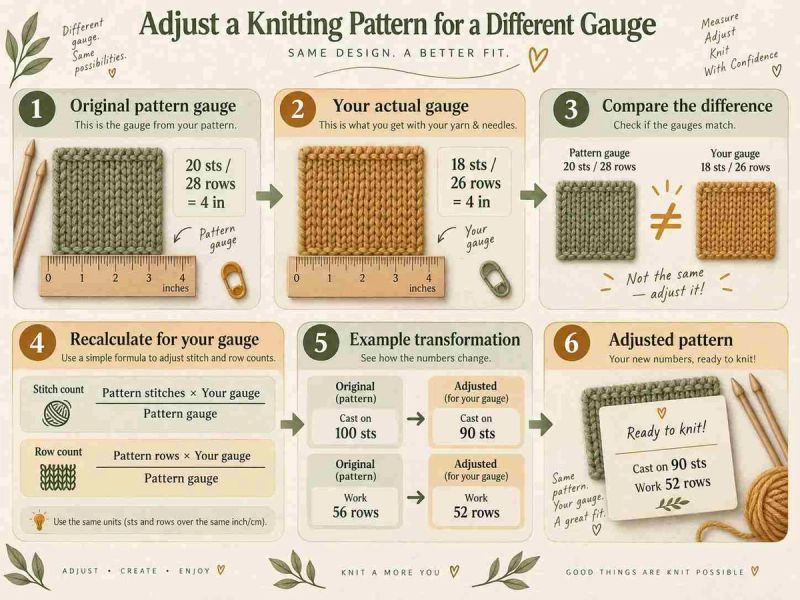
A practical method for resizing knitting patterns when your swatch gauge doesn't match the pattern, including worked examples, repeat constraints, and construction risks.
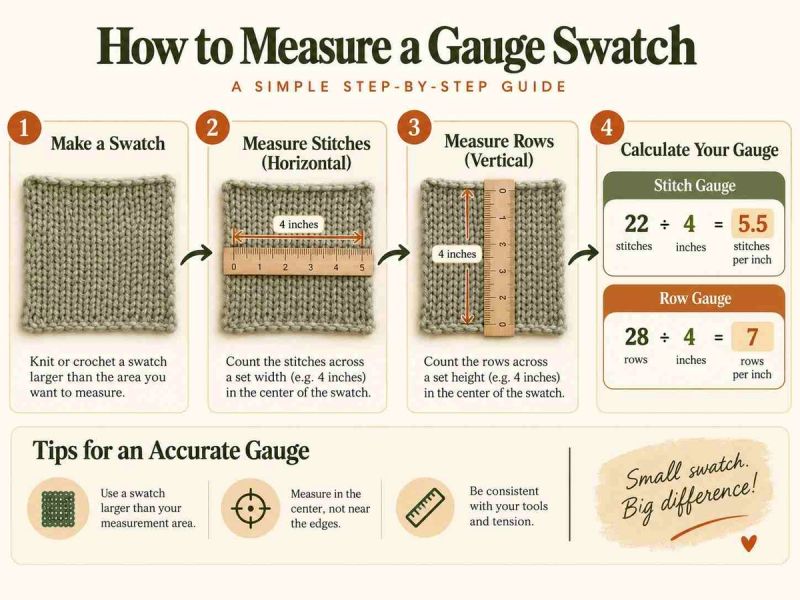
A step-by-step guide to measuring knitting gauge swatches correctly, with worked examples and troubleshooting for common measuring mistakes.
Something look wrong? Report a calculation or content problem.