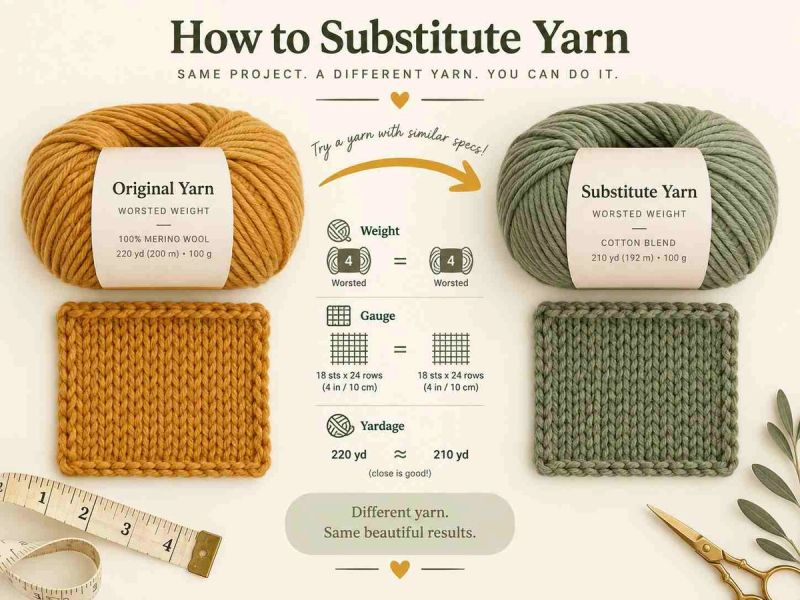
How to Substitute Yarn in a Pattern: A Practical Guide
A practical decision guide for replacing yarn in any knitting or crochet pattern. Covers gauge matching, fiber behavior, yardage math, construction, and swatching—with a worked example.
Maggie

Learn how yarn weight categories work, why the same yarn can have different names, and how to read labels for confident substitution.
Yarn weight describes thickness, not mass. The Craft Yarn Council's 0–7 category system is widely used in North America, while UK and Australian brands often use ply-based names that do not directly correspond. Always check gauge and recommended needle or hook size before substituting, and use wraps per inch (WPI) when a label is missing.
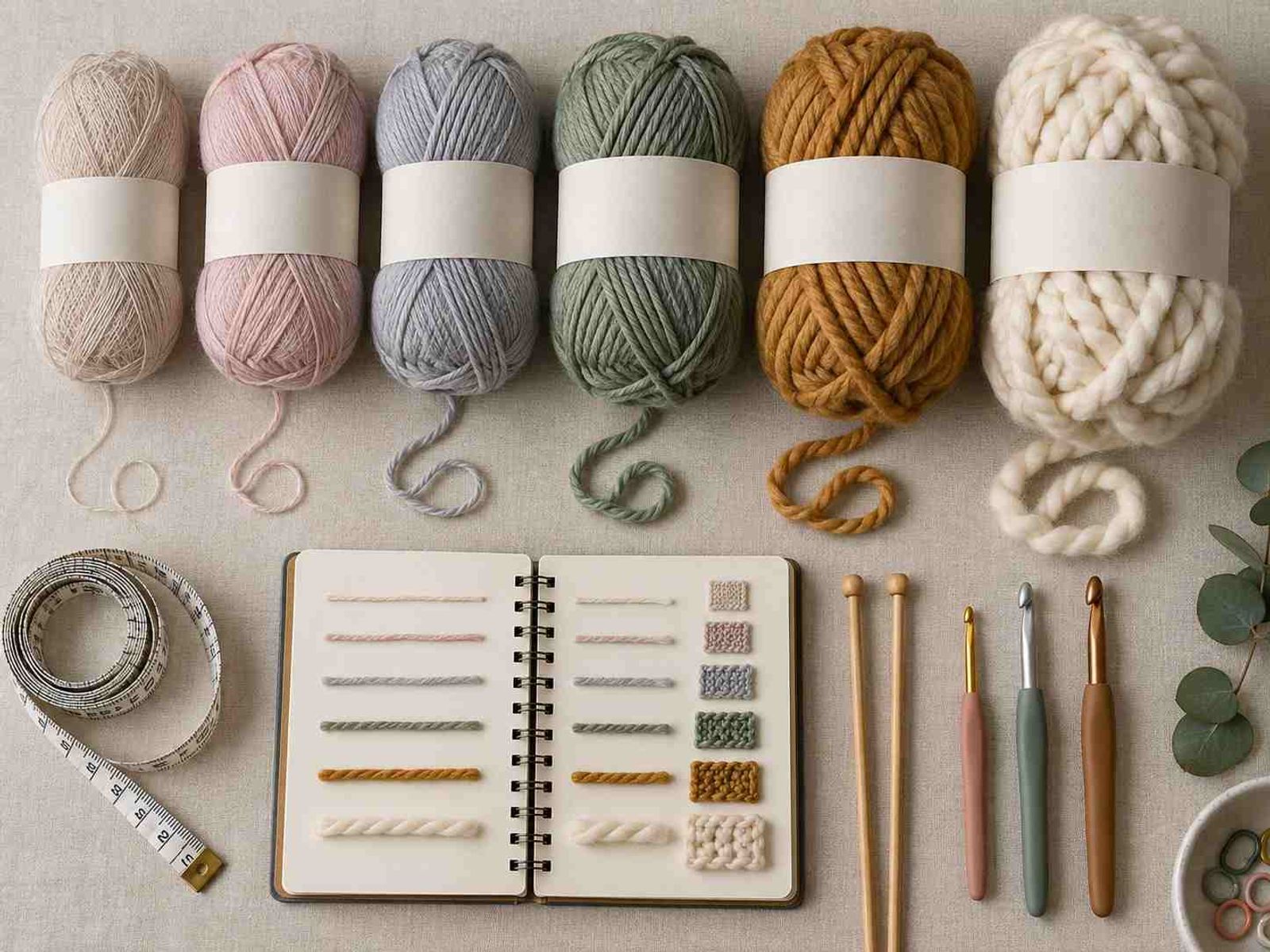
You pick up two skeins for a sweater. One label says "DK," the other says "light worsted." A third says "8 ply." They look close in thickness, but the needle recommendations differ by half a millimetre. You need to know: are these actually the same yarn weight? Can you swap them without rewriting the pattern?
This guide explains what yarn weight means, why naming systems conflict, and how to read labels so you can substitute with confidence.
In craft terminology, yarn weight refers to thickness, not how heavy a skein feels in your hand. A bulky yarn can weigh less than a fingering yarn if it is airy and loosely spun. What matters for your project is how wide each strand is, because that determines how many stitches fit into an inch—your gauge.
The Craft Yarn Council (CYC) defines yarn weight by the finished fabric characteristics a knitter or crocheter can expect: stitches per inch, recommended needle or hook size, and the typical gauge range. This is why two yarns in the same CYC category may look slightly different in the skein but behave similarly in fabric.
The CYC standard is the most widely referenced system in North American patterns and yarn labels. It sorts yarn into eight categories by thickness, from laceweight to jumbo.
CYC Category — Common Names — Approx. Gauge (knitting) — Needle Range (mm) — Typical Uses
0 Lace — Lace, fingering, cobweb — 33–40+ sts/4 in — 1.5–2.25 — Shawls, delicate openwork
1 Super Fine — Sock, fingering, baby — 27–32 sts/4 in — 2.25–3.25 — Socks, lightweight garments
2 Fine — Sport, baby — 23–26 sts/4 in — 3.25–3.5 — Light sweaters, accessories
3 Light — DK, light worsted — 21–24 sts/4 in — 3.5–4.5 — Garments, blankets
4 Medium — Worsted, aran, afghan — 16–20 sts/4 in — 4.5–5.5 — Versatile: sweaters, scarves, blankets
5 Bulky — Chunky, rug, craft — 12–15 sts/4 in — 5.5–8 — Quick accessories, outerwear
6 Super Bulky — Super chunky, roving — 7–11 sts/4 in — 8–12 — Heavy blankets, statement pieces
7 Jumbo — Roving, ultra — 6 or fewer sts/4 in — 12+ — Arm knitting, extreme textures
Source: Craft Yarn Council standard yarn weight system. Gauge ranges are typical; always swatch.
Notice that Category 4 Medium contains both "worsted" and "aran." In practice, aran is often slightly heavier than worsted—some brands place it at the top of Category 4, others treat it as edging into Category 5. This overlap is intentional: the categories are ranges, not precise measurements.
Three naming traditions cause most confusion:
System — Origin — Typical Terms — Key Quirk
CYC numeric — North America — 0–7 categories — Standardized but not universal
Descriptive — International — Lace, fingering, sport, DK, worsted, bulky — DK = "double knitting," a UK origin; no fixed mathematical meaning today
Ply-based — UK, Australia, New Zealand — 2 ply, 4 ply, 8 ply, 12 ply — Originally described strand count; now used as thickness shorthand
The critical mismatch: UK "4 ply" is roughly fingering weight (CYC 1), while UK "DK" is CYC 3. UK "aran" maps near CYC 4. But Australian "8 ply" often corresponds to DK (CYC 3), not double the thickness of 4 ply in a literal sense. The ply names have drifted from their original technical meaning.
Some manufacturers—especially those selling globally—print multiple systems on one label. Others use only their local convention. This is why two yarns that both say "DK" may not match if one follows a UK mill's tradition and the other follows a US distributor's interpretation.
Thickness is only one variable. A merino worsted and a cotton worsted in the same CYC category will behave differently:
Rule: Match CYC category first, then swatch to confirm gauge. If gauge does not match the pattern, the yarn is not a safe substitute even if the weight label agrees.
Wraps per inch (WPI) is a physical measurement: wrap the yarn snugly around a ruler or WPI tool, count how many strands cover one inch, and compare to a reference chart. It is especially useful when:
WPI belongs to measurement and identification, which is why theYarn Weight Calculatorhandles the interactive lookup. This guide focuses on understanding the systems; use the calculator when you have WPI data and need category confirmation.
When you pick up an unfamiliar skein, work through these checks in order:
Pattern calls for: Category 4 Medium worsted, gauge 18 sts/4 in on 5.0 mm needles.
Your stash yarn: Label says "DK / 8 ply," recommends 4.0 mm needles, gauge 22 sts/4 in.
Analysis: The stash yarn is Category 3 Light, not Category 4. Even if you knit it on 5.0 mm needles, you are unlikely to reach 18 sts/4 in without fabric that is too loose for the pattern's structure. Substitution would require pattern adjustment or a different yarn.
Better approach: Look for a yarn labeled Category 4, gauge 16–20 sts/4 in, needle range 4.5–5.5 mm.How to substitute yarncovers the full adjustment process.
Mistake — Why It Happens — Fix
Assuming "worsted" = "aran" — Both sit in or near Category 4 — Check gauge; aran often knits to fewer stitches per inch
Treating ply names as exact — 8 ply varies by country and era — Verify against CYC category or WPI
Ignoring fiber content — Same weight, different behaviour — Swatch and assess drape and elasticity
Using US and UK needle numbers interchangeably — US 8 = 5.0 mm; UK 8 = 4.0 mm — Always check millimetre sizing
Skipping the swatch — Trusting label gauge as guaranteed — Label gauge is a typical range, not a promise
This guide explains the systems. When you have a mystery yarn and a WPI measurement, theYarn Weight Calculatorconverts that measurement into a probable CYC category and suggests needle ranges. Use it as a confirmation tool, not a replacement for swatching.
Before your next project, gather your yarn candidates and compare: CYC category (or WPI), recommended needle size in millimetres, and label gauge. If all three align with your pattern, swatch once to confirm. If they diverge, consult theYarn Weight Calculatoror theyarn substitution guidebefore recalculating stitch counts.
For planning yardage once you have settled on a weight, seehow much yarn do I need.
A practical decision guide for replacing yarn in any knitting or crochet pattern. Covers gauge matching, fiber behavior, yardage math, construction, and swatching—with a worked example.
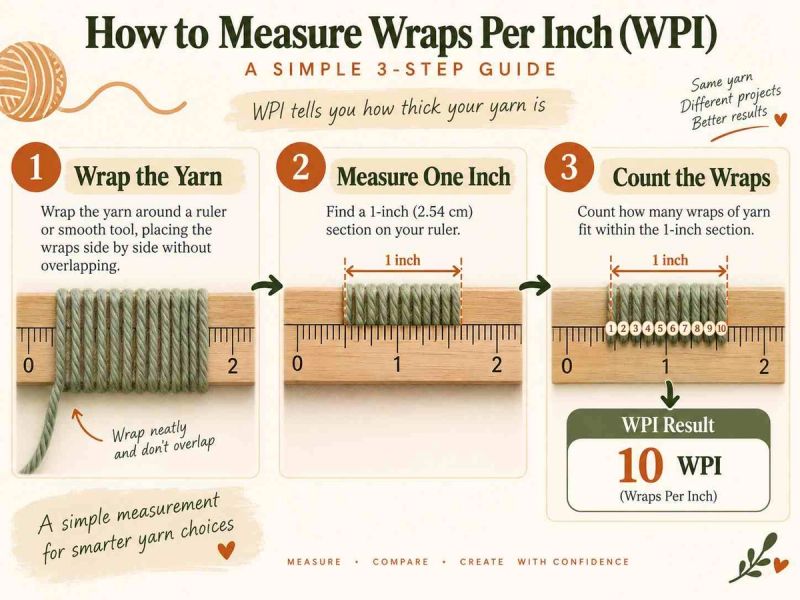
A step-by-step guide to measuring wraps per inch consistently, with troubleshooting for common errors and honest limits of what WPI can tell you.
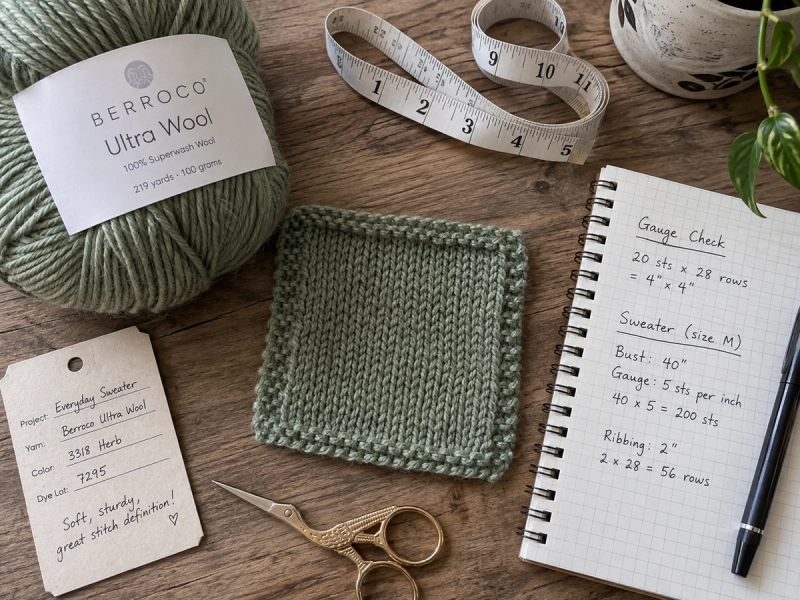
A practical guide to estimating yarn yardage: understand the variables that affect quantity, read yarn labels correctly, and know when to use a calculator for precise results.
Something look wrong? Report a calculation or content problem.