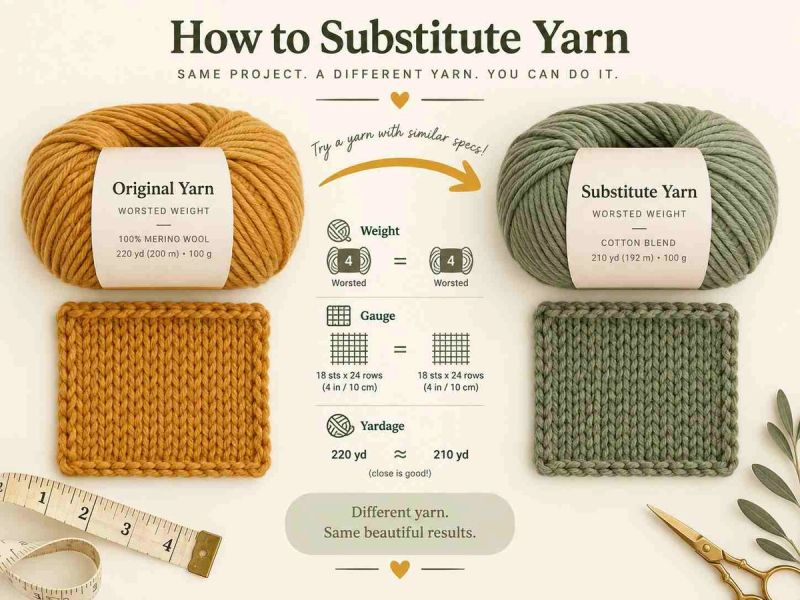
How to Substitute Yarn in a Pattern: A Practical Guide
A practical decision guide for replacing yarn in any knitting or crochet pattern. Covers gauge matching, fiber behavior, yardage math, construction, and swatching—with a worked example.
Maggie

A practical guide to estimating yarn yardage: understand the variables that affect quantity, read yarn labels correctly, and know when to use a calculator for precise results.
Yarn needs depend on project dimensions, stitch pattern density, yarn weight, and your personal gauge. Start with your pattern's stated yardage or a similar project's requirements, then add 10–20% safety margin. For precise estimates with your specific inputs, use a dedicated yarn calculator.
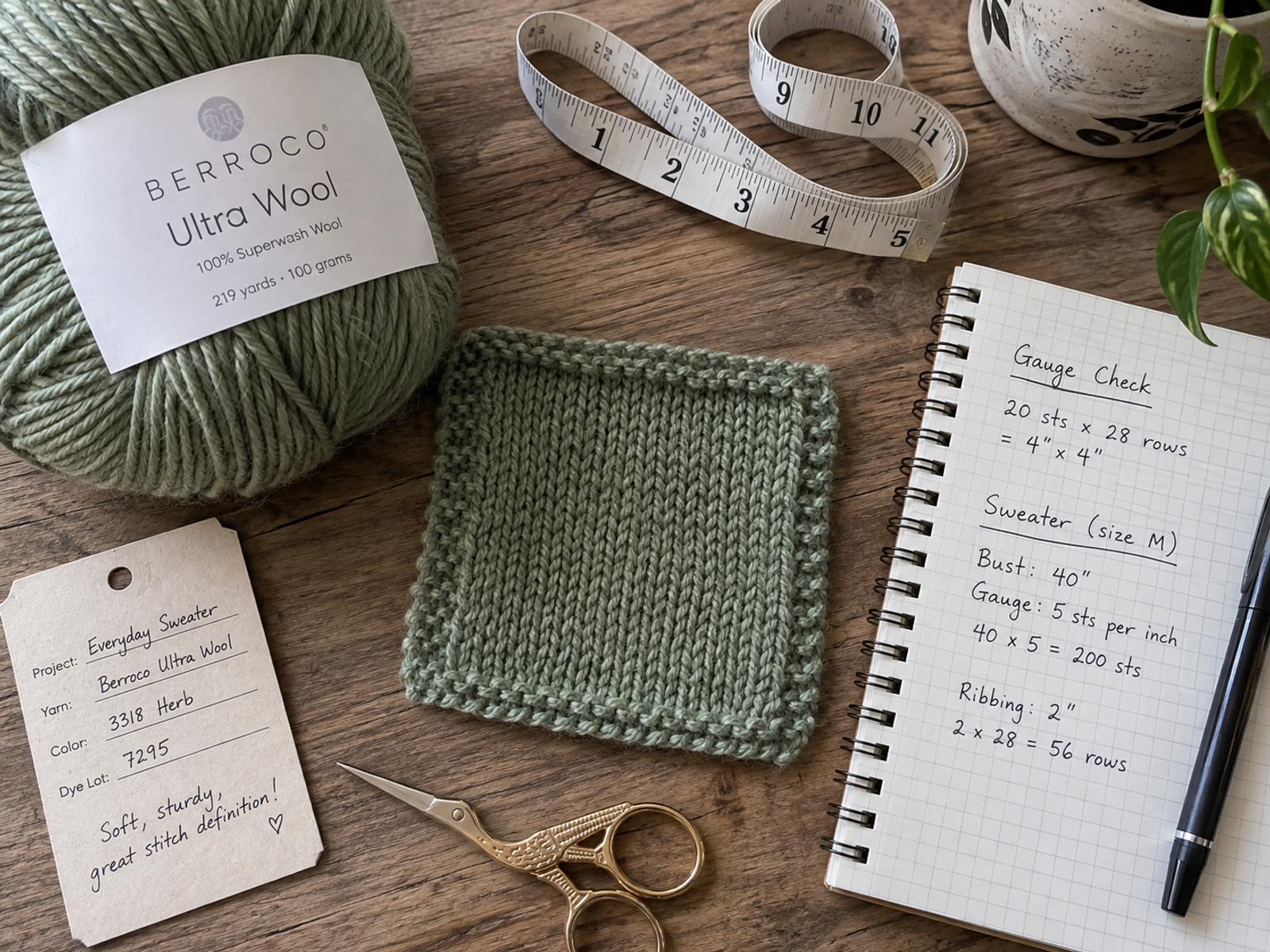
You're holding two skeins that look nearly identical—same color, similar softness—but one label reads 220 yards and the other 137 yards. Your pattern calls for "4 skeins," and you suddenly realize you don't know which skein the designer used. Buy too little, and you risk a dye-lot mismatch or a frantic mid-project hunt. Buy too much, and you've funded another project's worth of yarn you didn't plan for.
Here's the direct truth: there is no universal yardage per skein, and "skein" is not a measurement. The only reliable path is to work in yards or meters, account for the variables that change consumption, and add a safety margin.
Four factors dominate yarn consumption. Understanding them lets you adjust any estimate intelligently.
A scarf 6 inches wide and 60 inches long uses roughly half the yarn of one 12 inches wide and 60 inches long, assuming identical stitch and yarn. Surface area rules here. But length alone is misleading: a longer, narrower piece and a shorter, wider piece with the same square-inch area will use similar total yardage.
Dense stitches consume more yarn than open, lacy ones. A tightly worked single crochet or garter stitch blanket is heavier and hungrier than the same dimensions in filet crochet or mesh lace. Cables and textured stitches add 15–30% more yarn compared to plain stockinette or double crochet in the same yarn weight.
Thicker yarns cover area faster but not always proportionally. A bulky yarn may need fewer yards than a worsted for the same dimensions, but the relationship isn't linear—bulky stitches have more air between them. Yarn construction matters too: a lofty, airy roving-style bulky behaves differently from a dense, tightly twisted bulky.
Learn how yarn weight categories work and why they affect yardage calculations.
Your tension is yours alone. A "worsted weight" pattern written for 18 stitches per 4 inches will need significantly more yarn if you knit at 16 stitches per 4 inches—your fabric is looser, but you're making larger stitches that consume more yarn per row. Conversely, tighter knitters sometimes use less yarn for the same dimensions, though their fabric may be too stiff.
The yarn label is your primary source. Look for:
Critical habit: Always note whether your pattern lists requirements by yards, meters, grams, or skeins. If it says "4 skeins" without naming the specific yarn, you must find the original yarn's yardage to convert.
Let's walk through a concrete planning exercise.
Project: Garter stitch scarf, 8 inches wide × 70 inches long.
Step 1: Estimate from similar projects. A typical worsted-weight garter stitch scarf at these dimensions, knit at moderate gauge, uses approximately 350–450 yards based on common pattern data and Craft Yarn Council reference ranges for accessories.
Step 2: Check your yarn. Your chosen yarn: 220 yards per 100g skein, worsted weight.
Step 3: Raw calculation without margin. At the conservative end (400 yards): 400 ÷ 220 = 1.82 skeins. At the generous end (450 yards): 450 ÷ 220 = 2.05 skeins.
Step 4: Apply safety margin. Add 15% for gauge variation and the unexpected: 450 × 1.15 = 517.5 yards. 517.5 ÷ 220 = 2.35 skeins.
Decision: Purchase 3 skeins (660 yards total). This leaves you with approximately 140 yards—enough for repairs, a matching swatch, or a small coordinating piece, but not so much excess that you've overbought dramatically.
Scenario — Estimated Yardage — Skeins (220 yd each) — With 15% Margin — Final Purchase
Small scarf, loose gauge — 350 yd — 1.6 — 402 yd — 2 skeins
Medium scarf, average gauge — 400 yd — 1.8 — 460 yd — 3 skeins
Large scarf, dense/tight gauge — 500 yd — 2.3 — 575 yd — 3 skeins
Wide wrap, textured stitch — 650 yd — 3.0 — 748 yd — 4 skeins
Standard practice among makers and publishers is 10–20% above your best estimate. Use the higher end when:
Use the lower end when:
Even careful planning can go wrong. Watch for these failure modes:
Unlabeled or handspun yarn: No yardage data means weighing and measuring yourself, or working from a known sample.
Significant gauge drift: Many knitters tighten up during stress or loosen up with familiarity. A large project may shift gauge partway through.
Pattern errata or unclear requirements: "One skein of Yarn X" is useless if Yarn X has been discontinued or reformulated.
Frogging and reworking: Each rip-and-redo consumes yarn through handling, splitting, and minor waste. Budget extra for experimental or learning projects.
For projects where you have specific dimensions, stitch type, and yarn weight selected, manual estimation becomes tedious and error-prone. TheStittli Yarn Estimatoraccepts your project inputs and returns a calculated yardage range based on standard consumption models for knitting and crochet.
Use it when:
For converting between yarn weight standards or understanding how thickness affects your planning, theyarn weight calculatorprovides additional context.
Before you purchase: identify your project's finished dimensions, choose your stitch pattern, locate the exact yardage-per-skein for your candidate yarn, and apply a 15% margin. If you have precise inputs and want verification, run them through the Yarn Estimator. Then buy with confidence—not anxiety.
A practical decision guide for replacing yarn in any knitting or crochet pattern. Covers gauge matching, fiber behavior, yardage math, construction, and swatching—with a worked example.
Something look wrong? Report a calculation or content problem.