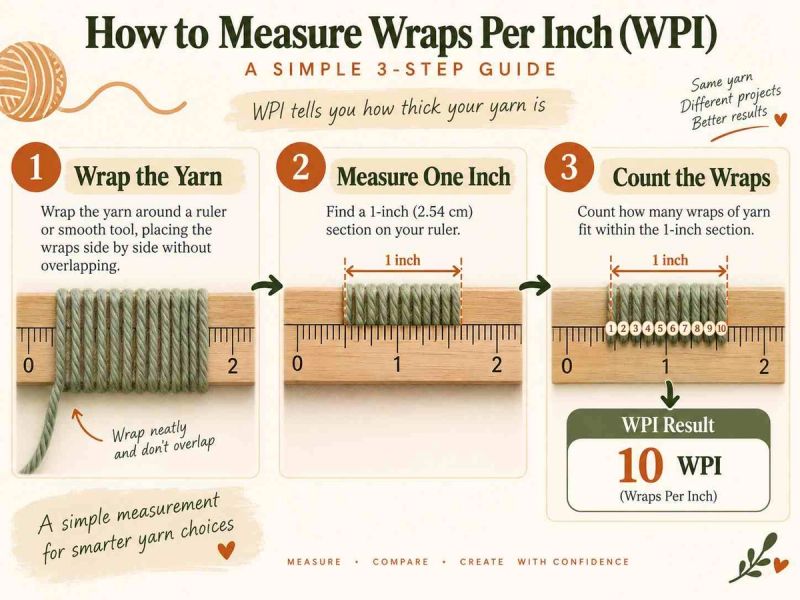
How to Measure Wraps Per Inch (WPI)
A step-by-step guide to measuring wraps per inch consistently, with troubleshooting for common errors and honest limits of what WPI can tell you.
Maggie

A practical decision guide for replacing yarn in any knitting or crochet pattern. Covers gauge matching, fiber behavior, yardage math, construction, and swatching—with a worked example.
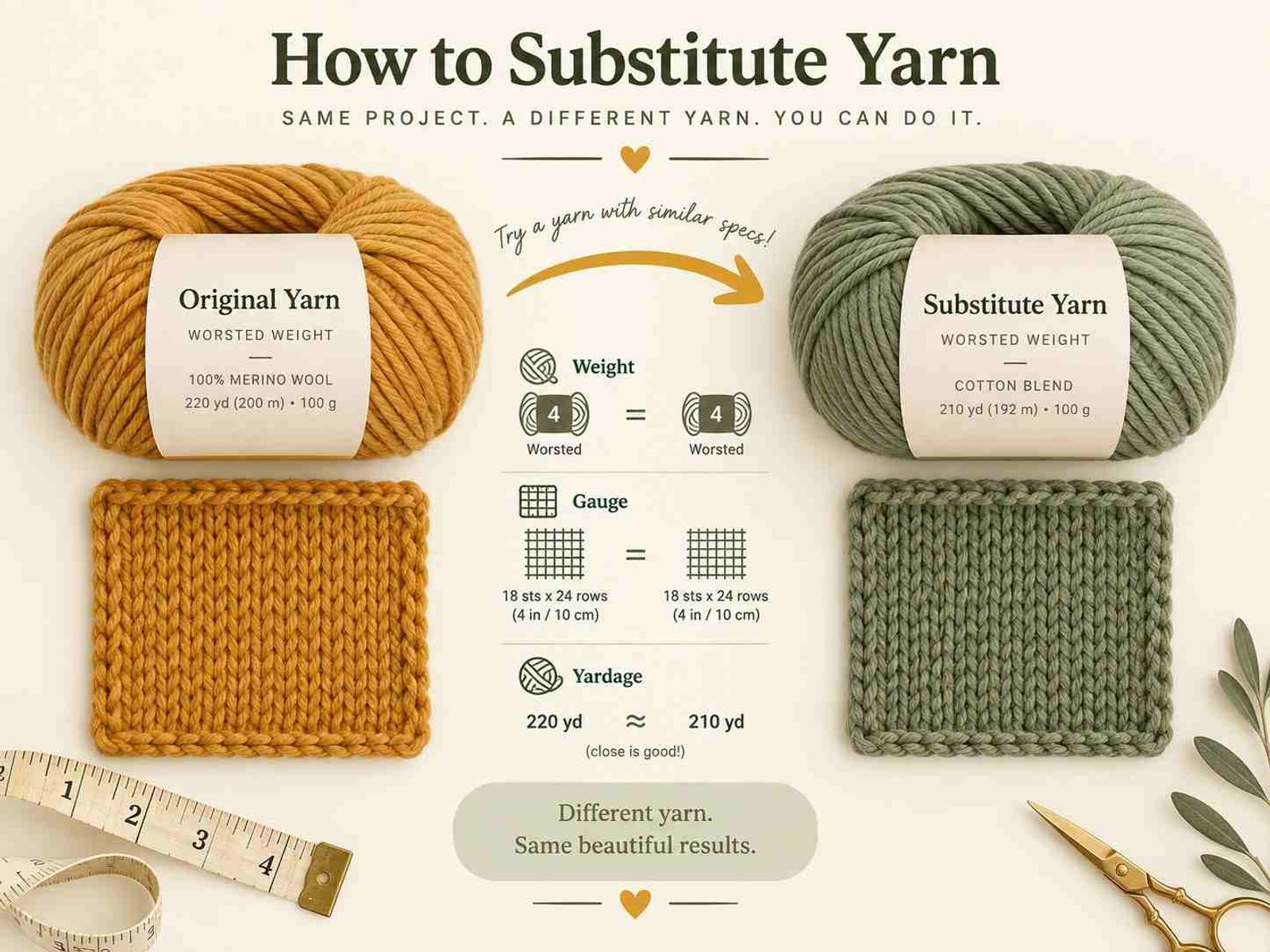
To substitute yarn successfully, match gauge (stitches and rows per inch) rather than relying on the weight name alone, then verify fiber behavior, construction, yardage, and drape with a washed swatch. Weight names like "DK" or "worsted" are marketing categories with real overlap, not precise measurements.
You found the pattern months ago. The photo shows exactly the drape and texture you want. Then you check the yarn: discontinued. Or available only overseas at triple the cost. Or a fiber you can't wear against your skin.
The natural first step is to search for the same weight name—DK, worsted, bulky—on another label. But weight names are broad marketing ranges, not guarantees. Two yarns labeled "worsted" can differ by 20% in thickness. Match the name and you may still end up with a garment two sizes off, stiff as cardboard, or that grows to your knees after the first wash.
Here's how to choose a replacement that actually works.
Before shopping, extract the real requirements from your pattern:
Write these down. They are your specification, not suggestions.
Gauge—stitches and rows per inch or centimeter—is the non-negotiable starting point. Patterns are written to a specific gauge; your fabric's dimensions depend on it directly.
Why weight names fail: The Craft Yarn Council's weight standards use broad ranges. A "worsted" yarn can range from 16–20 stitches per 4 inches (10 cm) in stockinette. That span covers fabrics from dense to quite open. TheCraft Yarn Council's yarn weight standardsdefine these categories, but manufacturers interpret them differently.
What to do:
Use theYarn Weight Calculatorto compare thickness evidence between the original and candidate yarns. It helps when labels use different numbering systems (wraps per inch, ply, or direct metric counts).
Fiber determines how a fabric lives after it leaves your needles or hook. Substituting cotton for wool without adjusting expectations leads to predictable failure.
Fiber/Fiber Family — Key Behavior — Substitution Risk
Wool (protein) — Elastic, memory, blooms when washed, warm — Loses shape recovery in plant-fiber swap
Cotton (cellulose) — Heavy, inelastic, grows with gravity, cool — Gauge may tighten; drape becomes denser
Linen — Stiff initially, softens with washing, crisp drape — Relaxes dramatically; swatch must be washed
Alpaca/Mohair — Drapey, warm, halo, low elasticity — Stretches under own weight; structure collapses
Silk — Lustrous, moderate elasticity, heavy drape — Slippery to work; gauge can shift
Synthetics (acrylic, nylon) — Variable by construction, often no memory, washable — Can be too springy or too limp; check blend ratios
Blends — Combines properties non-linearly — Test the specific blend; 50/50 behaves unlike either pure fiber
Critical rule: If the pattern depends on fiber behavior for its design—cable definition from wool's memory, lace openness from alpaca's drape—your substitution must preserve that behavior or the design intent changes.
Some makers successfully swap across fiber families by adjusting needle size and accepting different fabric character. This is a design choice, not a direct substitution. Be explicit with yourself about what you're changing.
Patterns often state "X skeins of Yarn Y." Skeins vary. A skein might be 50g, 100g, or 200g; 87 yards or 220 yards.
Always convert to total yardage or meterage.
Worked example:
Candidate substitute: New Yarn, 100g skein, 195 yards per skein
The substitute's skein contains less yardage despite identical weight. Buying 8 skeins leaves you 200 yards short—enough to stall most projects before finishing.
After choosing your substitute, use theYarn Estimatorto verify quantity for your specific pattern dimensions.
How yarn is built affects stitch definition, halo, and how light plays across the fabric.
Construction — Characteristics — Substitution Consideration
Single-ply — Soft, fuzzy halo, less durable, biased fabric — Hard to replicate with multi-ply; halo changes stitch clarity
2-ply — Balanced, good stitch definition, some elasticity — Versatile; check twist direction for bias
3-ply or more — Round, durable, good stitch definition — Common default; easiest to match
Cabled — Dense, structured, very durable — Heavy; affects gauge and drape significantly
Chainette — Light, airy, trap structure — Gauge behaves differently; swatch essential
Tape/ribbon — Flat, crisp edges, no elasticity — Specialized; rarely substitutable for round yarns
Bouclé/eyelash — Textured, obscures stitch pattern — Substitute only for same texture category
A smooth 4-ply merino will not produce the same fabric as a single-ply woolen-spun yarn of identical gauge. The pattern's texture may disappear or emerge too sharply.
Hand-dyed and small-batch yarns have visible lot variation. When substituting:
This is the step most often skipped, and the step that prevents most substitution failures.
Procedure:
What to compare:
If gauge doesn't match: Try a different needle/hook size first. If two size changes fail, the yarn's construction or fiber is incompatible with the pattern's density requirements.
Pattern: Cropped cardigan, size M Original yarn: Fingering-weight merino-nylon blend, 400m/100g, gauge 28 sts × 36 rows = 10cm in stockinette Problem: Original discontinued; reader has sensitivity to nylon
Step 1: Requirements extraction
Step 2: Candidate search
Step 3: Initial screening
Step 4: Swatch decision
Step 5: Yardage verification
Result: Successful substitution with intentional adjustments for fiber difference.
Failure — Cause — Prevention
Garment too large/small after washing — Fiber grew or shrank; gauge shifted — Wash swatch completely; measure post-block
Fabric stiff or board-like — Substitute denser than original; fiber lacks drape — Match grist (length per weight) as well as gauge; check fiber family
Stretched sleeves/hem — Low-elasticity fiber under gravity — Add structure (ribbing, seams) or choose more elastic fiber
Halo obscures cables/lace — Single-ply or fuzzy substitute for smooth original — Match construction type, not just gauge
Ran out of yarn — Miscalculated skein-to-yardage conversion — Always convert to total yardage; round up
Visible dye shift mid-project — Different dye lots purchased separately — Buy full quantity upfront; verify lot numbers
Sometimes no available substitute satisfies enough criteria. If:
Consider finding a pattern written for yarn you can source. The time invested in forced substitutions often exceeds starting fresh.
Gather your pattern's gauge and yardage requirements, then use theYarn Weight Calculatorto compare your original yarn against candidates. Once you've selected a substitute, run your final quantities through theYarn Estimatorbefore purchasing. For deeper context on how weight categories work, see ouryarn weights explainedguide, and for quantity planning after any substitution, ourhow much yarn do I needguide.
Substitution is not about finding an identical yarn. It is about understanding what the pattern actually needs and verifying that your choice delivers it—before you knit the first sleeve twice.
A step-by-step guide to measuring wraps per inch consistently, with troubleshooting for common errors and honest limits of what WPI can tell you.
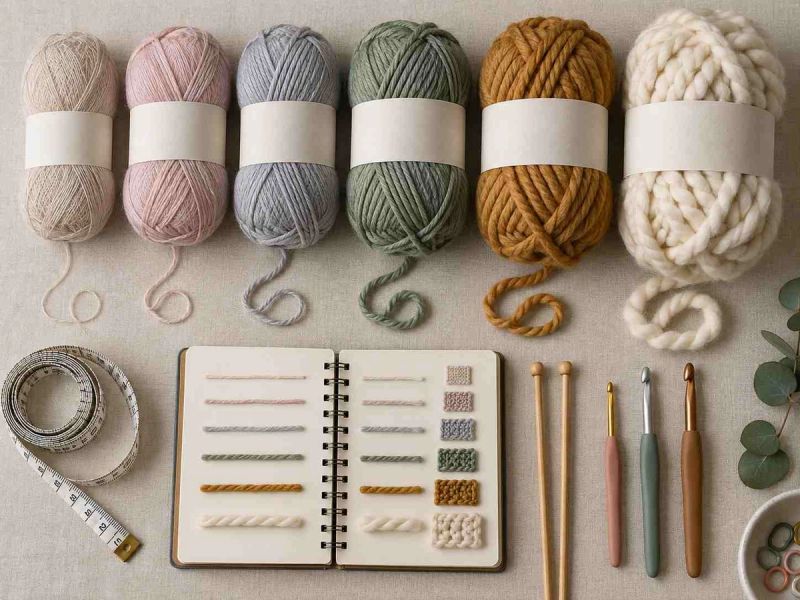
Learn how yarn weight categories work, why the same yarn can have different names, and how to read labels for confident substitution.
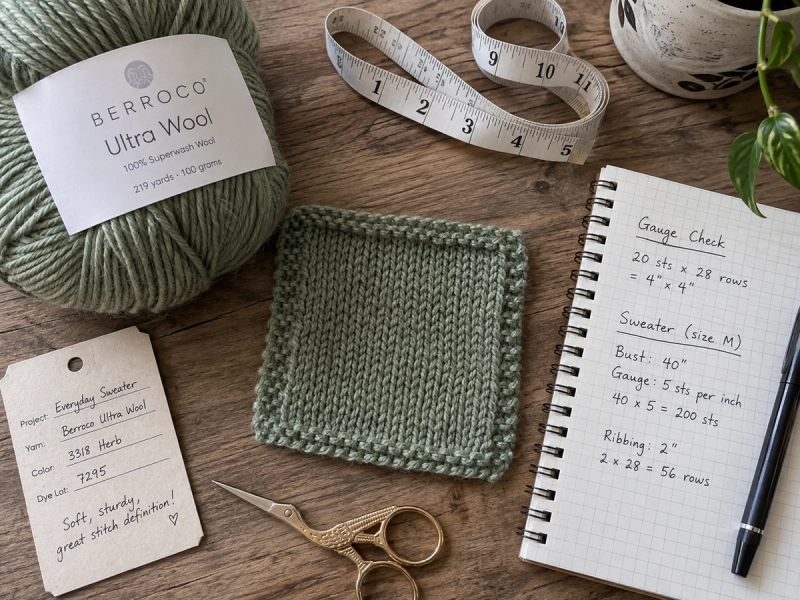
A practical guide to estimating yarn yardage: understand the variables that affect quantity, read yarn labels correctly, and know when to use a calculator for precise results.
Something look wrong? Report a calculation or content problem.