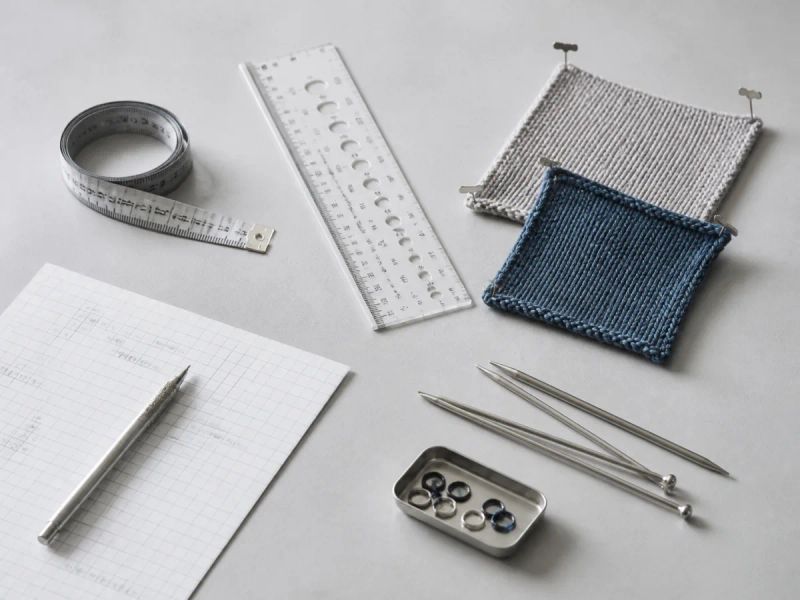
What Is Gauge in Knitting and Crochet?
Gauge is the number of stitches and rows in a measured area. Learn why a washed swatch matters and how to adjust when your gauge is different.
Maggie
Convert knitting needle sizes between metric/mm, US, and UK with one practical chart, plus circular and old-needle-size guidance.
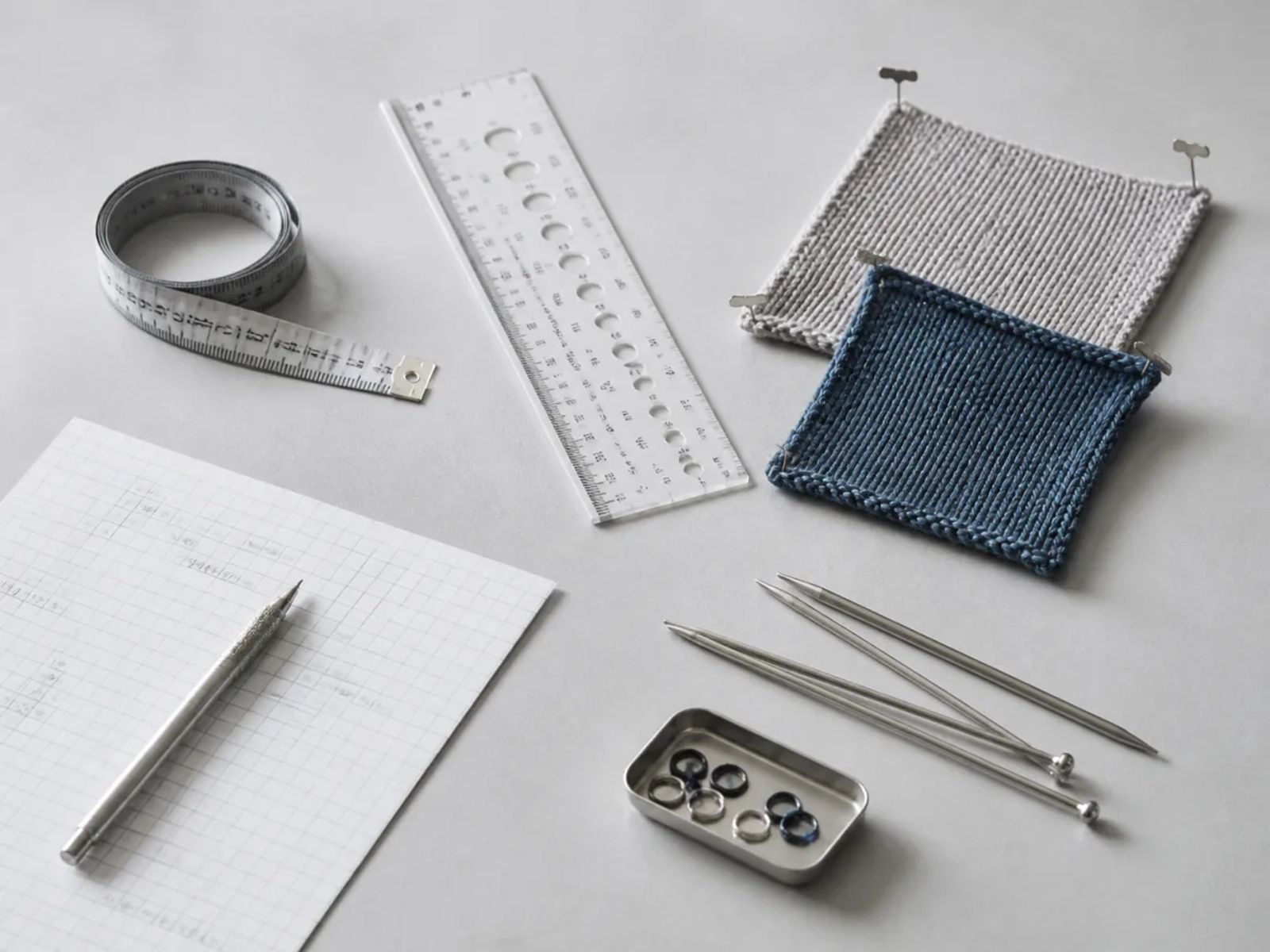
Metric (mm), US, and UK are three different labeling systems for the same knitting needle diameter. This chart converts between them so you can read any pattern, needle package, or size label at a glance.
| Metric (mm) | US size | UK size |
|---|---|---|
| 2 | 0 | 14 |
| 2.25 | 1 | 13 |
| 2.5Some manufacturers use US 1½. | No exact equivalent | No exact equivalent |
| 2.75 | 2 | 12 |
| 3Some manufacturers use US 2½; selected authorities do not provide a universal US equivalent. | No exact equivalent | 11 |
| 3.125CYC also maps US 3 to 3.25 mm; metric diameter controls. | 3 | No exact equivalent |
| 3.25CYC also maps US 3 to 3.125 mm; metric diameter controls. | 3 | 10 |
| 3.5 | 4 | No exact equivalent |
| 3.75 | 5 | 9 |
| 4CYC also maps US 6 to 4.25 mm; metric diameter controls. | 6 | 8 |
| 4.25CYC also maps US 6 to 4 mm; metric diameter controls. | 6 | No exact equivalent |
| 4.5 | 7 | 7 |
| 5 | 8 | 6 |
| 5.25CYC also maps US 9 to 5.5 mm; metric diameter controls. | 9 | No exact equivalent |
| 5.5CYC also maps US 9 to 5.25 mm; metric diameter controls. | 9 | 5 |
| 5.75CYC also maps US 10 to 6 mm; metric diameter controls. | 10 | No exact equivalent |
| 6CYC also maps US 10 to 5.75 mm; metric diameter controls. | 10 | 4 |
| 6.5 | 10½ | 3 |
| 7Some manufacturers use US 10¾; no universal equivalent in selected authorities. | No exact equivalent | 2 |
| 7.5Some manufacturers use US 10⅞; no universal equivalent in selected authorities. | No exact equivalent | 1 |
| 8 | 11 | 0 |
| 9 | 13 | 00 |
| 10 | 15 | 000 |
| 12 | No exact equivalent | No exact equivalent |
| 12.5CYC also maps US 17 to 12.75 mm; large-size manufacturer mappings vary. | 17 | No exact equivalent |
| 12.75CYC also maps US 17 to 12.5 mm; large-size manufacturer mappings vary. | 17 | No exact equivalent |
| 15Large-size mappings vary; some references associate US 19 with 16 mm. | 19 | No exact equivalent |
| 16Some references associate 16 mm with US 19; no universal mapping selected. | No exact equivalent | No exact equivalent |
| 19 | 35 | No exact equivalent |
| 20 | No exact equivalent | No exact equivalent |
| 25 | 50 | No exact equivalent |
Where a system has no exact equivalent for a given millimetre size, the cell reads “No exact equivalent” rather than forcing a nearby label.
Source: Craft Yarn Council — Hooks & Needles — Primary US/mm dataset and manufacturer-variation warning.
Source: Vogue Knitting — Knitting Needle Conversion Chart — Legacy UK mappings and conventional-row cross-check.
Source: ChiaoGoo — 2022 Product Catalog — Manufacturer-specific fractional-label caveat.
Start with the size written on your pattern or needle package, find it in that column, and read across the row to see the other systems. Treat a “No exact equivalent” cell as exactly that — do not round a millimetre size up or down to make a label fit.
3 mm corresponds to UK 11, with no universal US equivalent (some manufacturers use US 2½). 3.5 mm is US 4. 4 mm is US 6 and UK 8.
US and UK labels are regional numbering conventions, while metric expresses the needle's actual diameter in millimetres. Because the number systems evolved separately, similar-looking numbers do not mean the same diameter — a US 6 and a UK 6 are different sizes.
The millimetre diameter is the stable, system-neutral comparison point. When a conversion is ambiguous, read from the US or UK label to the millimetre value first, then to the other system.
The size of a circular needle refers to the tip diameter, so the same conversion table applies to straight, double-pointed, and circular needles. Circular needles also have a separate cable length, chosen for the project circumference or technique — that is not converted by this chart.
Vintage patterns may use older regional number systems, while modern packaging usually foregrounds millimetres. Resolve an old numeric label through the millimetre diameter where a source supports a direct mapping, and remember that “old” and “new” are not globally uniform — country, date, and manufacturer matter.
Charts can differ at uncommon sizes, and manufacturers may label or measure products differently. Prefer the manufacturer's printed millimetre diameter and follow the pattern designer's instructions.
Gauge is the number of stitches and rows in a measured area. Learn why a washed swatch matters and how to adjust when your gauge is different.
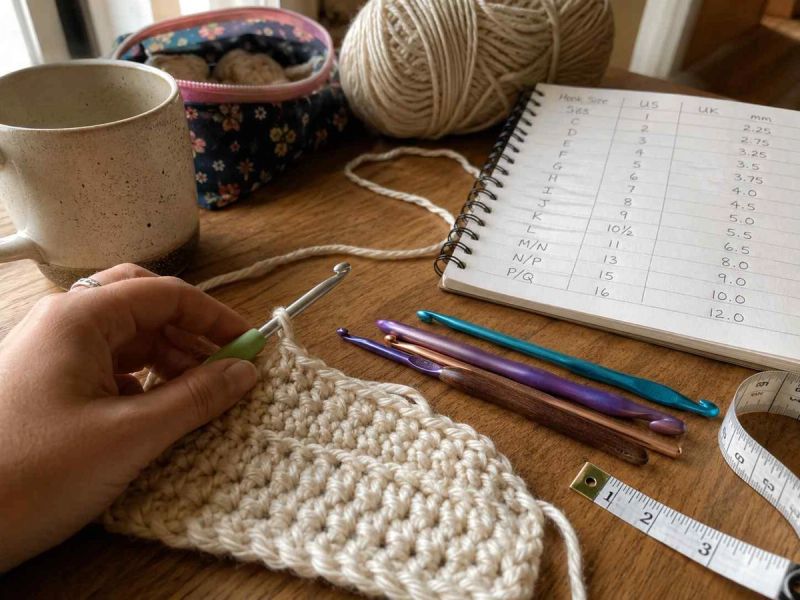
Use this crochet hook size chart to convert common hook sizes between US, older UK, and metric measurements, then check your gauge before starting.
Something look wrong? Report a calculation or content problem.